
Categories
The rise of wing sails for superyachts
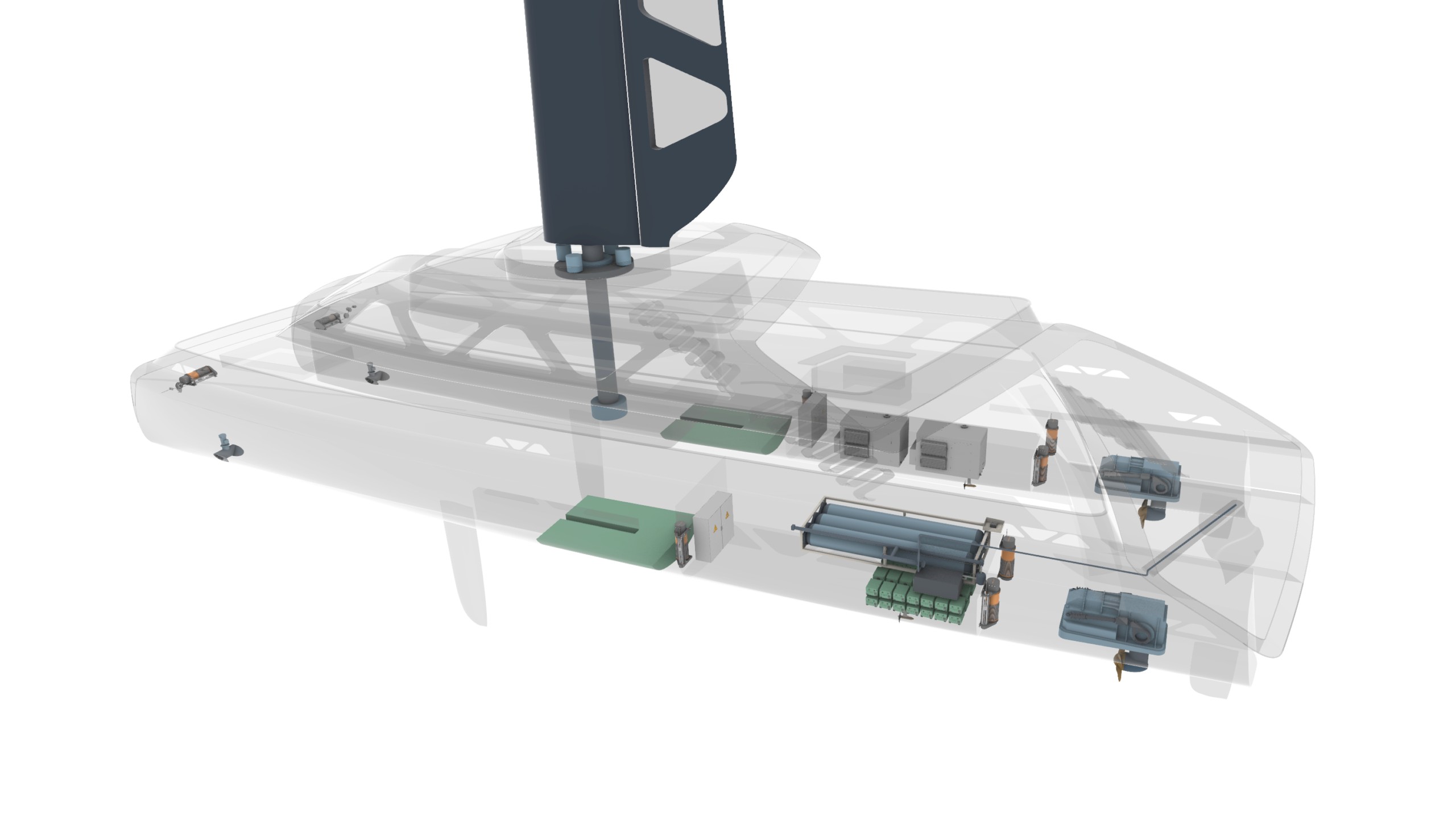
Royal Huisman recently released the design for Aera, a futuristic eco-friendly catamaran design that features a wing sail, rather than a traditional soft sail found on superyachts classified as “sailing” superyachts.
The use of a wing sail signals a potential change in the market for and classification of superyachts. The commercial maritime industry is now aggressively experimenting with several types of wind-assisted propulsion systems. The aim is not to replace diesel or electric propulsion, but to use wind assist technology to cut fuel consumption and thereby reduce emissions. Wind-assist propulsion also allows vessels to recharge batteries, which increases the range and time that a vessel may operate on batteries only.
The traditional problem with sailing superyachts for owners has been the reduction of onboard space required for a sailing vessel, as well as the deck space required for extensive rigging and the additional crew needed for furling and unfurling soft sails. Such restrictions have kept the market for sailing superyachts to about 10% of the total market and limited the actual time that sailing yachts actually use their sails.
The DynaRig, pioneered by legendary superyacht owner Tom Perkins and championed by Southern Spars, was meant to address the shortcomings of traditional sailing yachts by automating much of navigation under sail and freeing crew from rigging work. Yet, it has never taken off. To date, only Perkins’ Maltese Falcon and the Black Pearl sport the DynaRig.
Can the Wing Sail do better?
“Wing sails onboard for example catamarans have a strong potential and signal a shift in the market,” said Rondal Managing Director Harald Lubbinge in a recent Q&A. Rondal designed the wing sail and rigging for Aera. He added that owners are interested in lower emissions and better energy use, but that solutions need to be easy to operate.
The wing sail solution aboard Aera blurs the line between sailing yacht and motoryacht. Royal Huisman even asks if Aera is “a super-efficient sailing yacht” or “a motoryacht that gets a big boost from wind”?
Lubbinge described the Aera project as “mature”, with approval-in-principal from Lloyd’s Register for the Aero Wing. “That’s a meaningful step, because it validates the design and safety principles and helps move toward real-world application. We took this a step further with promising catamaran projects (Dragonfly by Dixon Yacht Design and Royal Huisman’s Aera). Working with Artemis Technologies we developed the design for a wing sail large enough to serve superyachts,” Lubbinge said.
Royal Huisman says that, unlike the DynaRig, Aera’s 245 square metre wing sail can rotate 360 degrees for sailing performance on almost all points of sail or to depower quickly. No additional sails, sheets, blocks, furlers or winches are required. Two electric motors inside the yacht rotate the wing mast. Hydraulic cylinders control adjustable flaps along the trailing edge to generate the most power or reduce power completely.
The Aera is the latest design proposal to feature a wing sail solution. In 2024 ModX, a French yachting start-up in conjunction with Aeroforce, launched the ModX 70 catamaran. This zero-emission yacht made use of inflatable wing sails to help achieve complete independence from fossil fuels and to serve as a prototype.
Wing sails have already replaced traditional soft sails in America’s Cup racing, and the two leading proponents of wing sail technology, Artemis Technologies and BAR Technologies, emerged from America’s Cup competition.
There are other modern solutions to the problem of efficiently capture wind power for propulsion, including Flettner Rotors, Suction Sails, and Kite Sails. All of these are being considered by the commercial maritime industry, with Flettner Rotors acquiring considerable attention. However, the round tower shape of a Flettner Rotor isn’t eye-appealing. Kite Sails have been deployed on a trial basis on smaller catamarans, but their usage is limited to the open ocean.
Will wing sails help blur the line between motor and sailing yacht? The answer will likely depend on which system is easier and less expensive to operate.