
Categories
Smart shading: the art of keeping owners (almost) in the dark
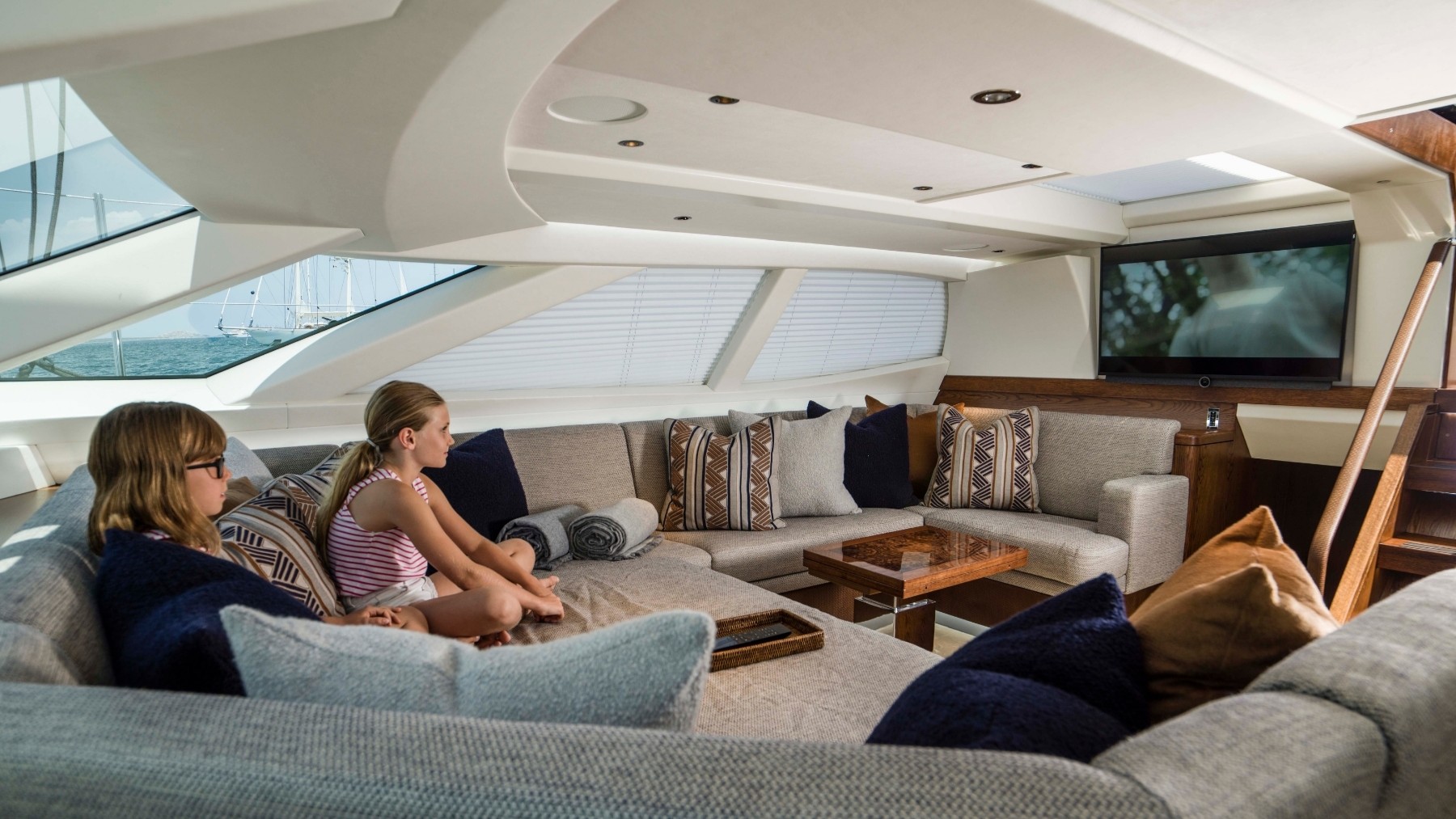
A surprisingly important part of a superyacht’s onboard ambience is down to something surprisingly simple: shading technology. After all, busy nights might require a lengthy lie-in the following day.
Getting light levels right is no mean feat. It requires coordination between sensors, actuators, and input technologies. Add to that the fact that the open ocean can be a very bright place in the middle of a sunny day.
Consider the guidance systems needed for sliding shade systems. “A shading guidance system on a yacht is quite a bit different from those on land,” says Daniel Kerkhof, director of Crestron Marine. He points to the fact that structures and working parts need to be built right into the walls of cabins and saloons of a vessel in motion. “Fitting a shade into a cabin requires a lot of very precise manual labour,” says Kerkhof.
The irregular shapes that are now de rigueur on custom superyachts present other challenges. “We were working on a sailing catamaran that looked very rounded from the outside, and all the spaces on the top deck had a lot of curvature in the exterior walls. The windows followed that curve — and the windows themselves were trapezoidal,” says Kerkhof.
Creating complete blackouts, where almost no sunlight enters a cabin, during daytime presents additional headaches. Kerkhof describes how one client required blackout fabric that was installed on a dual-roller system with the blackout shade nearest the window and a customised Roman shade to match the interior design of the vessel.
Keeping quiet
Noise reduction is a common aspect of superyacht design, and that extends to the smallest details. Kerkhof says that Crestron has developed very quiet motors to go into the ceilings of its installations. He adds that while an individual superyacht can be quite large, individual cabins are tight spaces that amplify sound.
“Very often, there are a lot of windows in those cabins relative to the size of space, but because those windows are fairly small, you’ll see three or four right next to each other,” says Kerkhof. “But if you've got three or four dual systems, that means eight motors in a relatively small space. If you start moving them all together at the same time, the potential for noise can be downright alarming.”
Crestron shading technology also focuses on energy efficiency. “We make a power supply unit for 10 shades that’s decentralised, but that unit itself just goes over Ethernet back to the control processor. The unit is powered via a local power socket and just the Ethernet connection goes back to the control system. The whole backbone of those units is all Ethernet-based,” says Kerkhof.
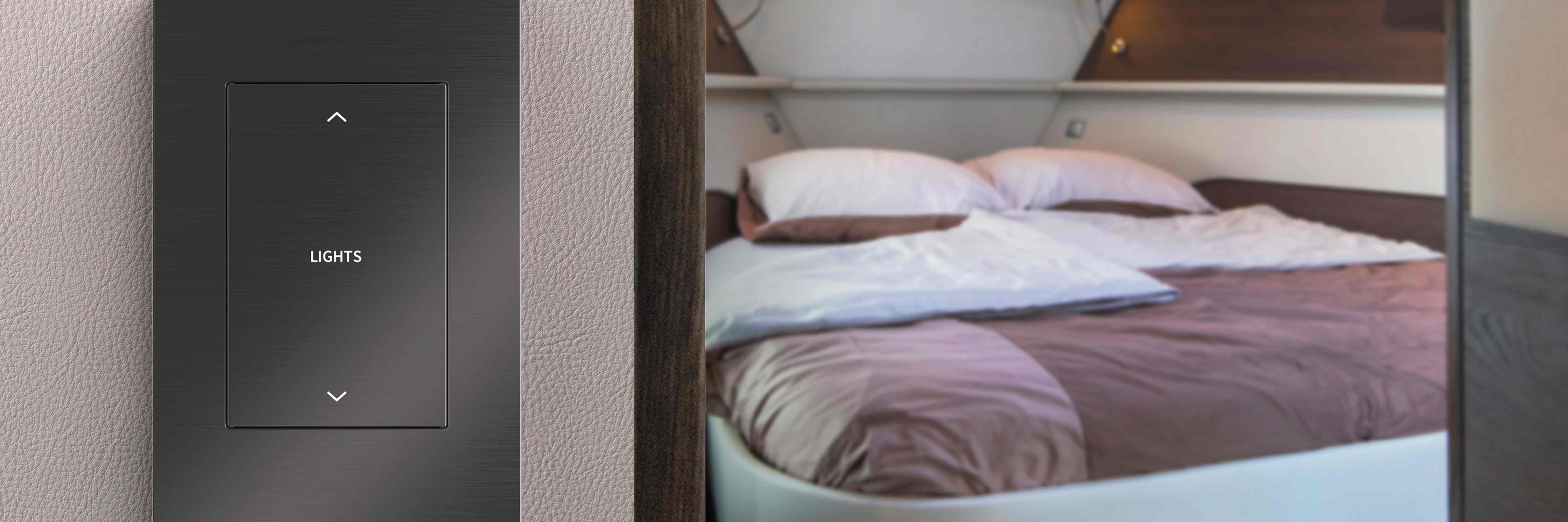
Finally, there are the control panels and mechanisms that superyachts need to get right for guests. Crestron produces flush-mount keypads and dimmers that are popular on superyacht projects. Kerkhof estimates that 80% of superyacht project managers specify Crestron controls for this purpose.
Touchless control is also important. Clock-based automation that aligns with sunrises and sunsets is also popular and a big plus for superyachts, but these demand additional cable run space and, therefore, additional solutions.
“The windows aren’t big, but they’re numerous — and when you factor in the need for two layers of shading (and each layer’s motor), the numbers can multiply quickly. I’ve seen yachts that easily require 200-plus systems,” says Kerkhof.
Having everything live on the network, though, has been an enormous leap forward for marine integrations as a whole. “Sending everything from AV-over-IP to lighting and shading to climate control over Cat cabling has made everyone’s life easier. It was a development that we helped pioneer,” Kerkhof concludes.
Editor's Note: This interview was originally published by Crestron