
Categories
Schottel grows rapidly in the superyacht propulsion market
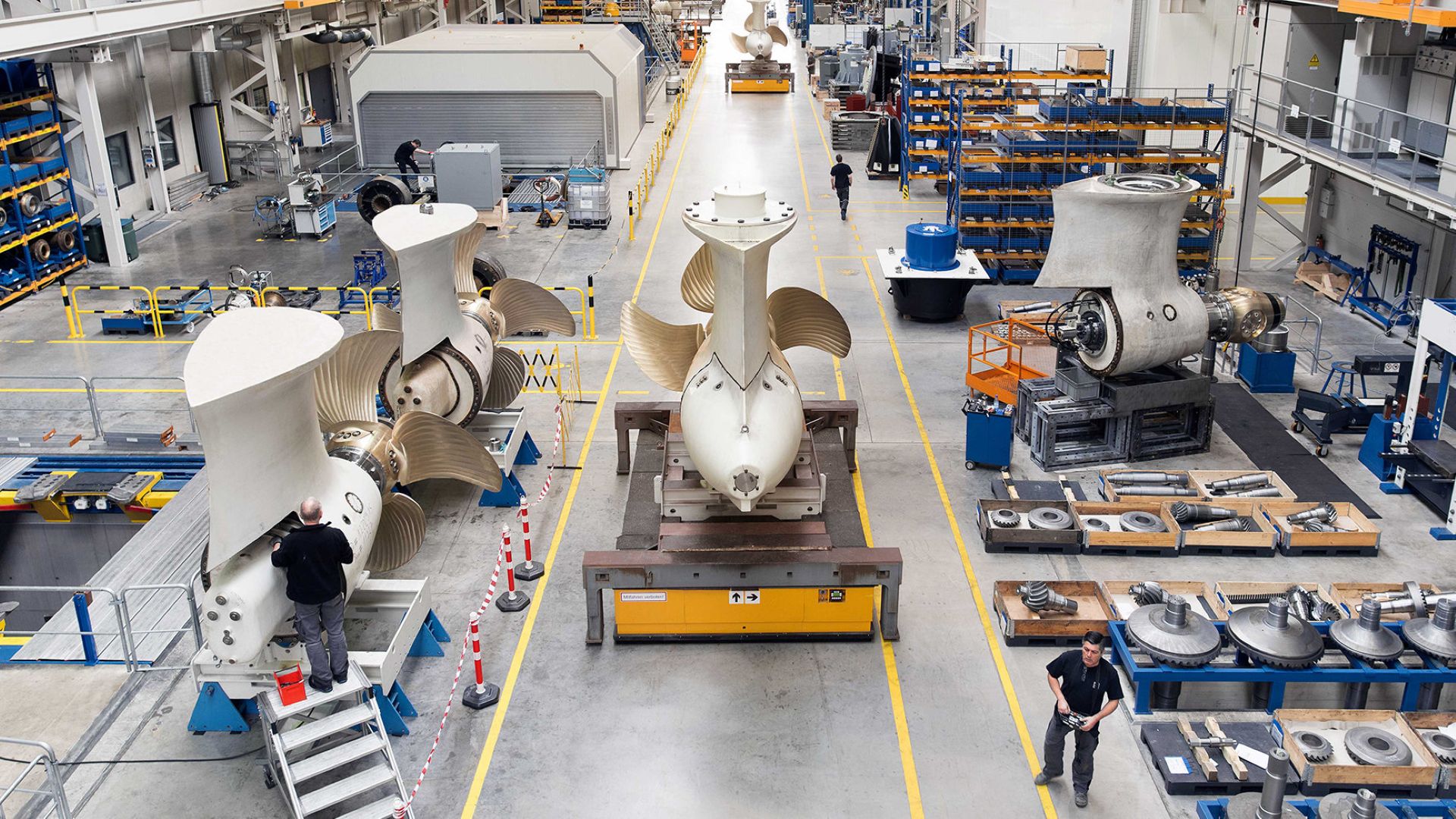
German propulsion specialist Schottel, with a large proportion of its products focused on the offshore energy industry, is quickly muscling its way into the superyacht propulsion market with its EcoPeller forward-facing azimuthing thruster. Schottel now has 20 superyachts on order with EcoPellers to be installed as main propulsion, according to Andreas Witschel, Schottel’s Sales Director for passenger vessels and superyachts and a 25-year veteran of the superyacht industry.
Schottel began developing the EcoPeller specifically for double-ended ferries in 2015 with a particular view to the electrification of such vessels. Witschel says that in 2022, the company began developing a version suited for the luxury superyacht market with an even greater focus on efficiency and noise reduction.
Witschel noted that the increasing request for compactness from the superyacht market led Schottel to further refine the EcoPeller. In partnership with the University of Dresden, Schottel found ways to reduce the space required for the gearing inside the EcoPeller’s housing, which meant a slimmer design relative to a larger propeller diameter, further boosting efficiency. Schottel also pioneered a unique, elastic mounting system that further insulates the vessel from high-frequency noise. As a pulling azimuth thruster, the EcoPeller enjoys an even wake water intake to the propeller disc.
One key element in the design of the EcoPeller was moving the propeller as far forward from the vertical strut as possible, reducing interaction in the water flow between propeller and strut. This, Witschel says, further enhanced efficiency while also reducing noise and vibration. “This is a standalone feature of a Schottel product,” he says. Because the propellers are forward-facing, Witschel says that vessels can maintain their course better than on aft-facing or contra-rotating propellers, where more frequent course corrections might be necessary during transits.
Schottel now has a range of compact EcoPellers for the superyacht market, starting with a 500 kW model up to a 2,500 kW model per thruster.
The company offers a combination of propulsion systems aimed at the superyacht market. Through a combination of a tunnel thruster and an electrically-driven PumpJet with full 360° azimuth steering capability, conventional superyachts equipped with diesel engines, gears, shaftlines and rudders can achieve better manoeuvrability and even use dynamic positioning to allow for electronic anchoring. Witschel says Schottel’s PumpJets, which intake water from below and then radiate directed water almost horizontally out and which sit flush in a superyacht’s hull, are extremely compact and can propel the yacht at low speeds in harbours and shallow waters while the main shaftlines remain stationary. This effectively creates a hybrid operating mode by utilising the electrical power already available on board to drive the PumpJet.
The Pods are coming
Witschel believes that superyacht builders and owners will continue to switch to pod solutions for main propulsion and away from classic propeller and shaftline solutions. Part of the reason for this is down to the advantages in manoeuvrability and the significant space savings in the aft section compared with conventional shaft line arrangements. A vessel trying to fit into a tight berth or navigate a narrow channel can use much less fuel than required with a prop and shaft configuration.

Andreas Witschel believes pod solutions will become more popular with superyacht builders and owners
Further, pod solutions allow for greater space below deck for storage or accommodation. Pods such as the EcoPeller can also be fitted to operate at 90 degrees to the water flow thereby reducing noise levels and improving propulsive efficiency, rather than at a downward angle as required by shaftlines. The EcoPeller features a permanent magnet motor located inside the vessel. This design enables easy maintenance and eliminates components such as slip-ring transmitters for electrical power transmission.
But perhaps the key reason that Witschel is optimistic about the future of pod propulsion for superyachts is that owners are becoming more conscious of fuel consumption and lower onboard noise levels. Increasingly stringent environmental regulations are making the installation of diesel direct-drive propulsion systems progressively more challenging.
There is also the realisation that, while a prop and shaftline vessel may achieve a top speed higher than a podded propulsion system, a drop in speed by a few knots can achieve big fuel savings. Superyachts typically operate at top speed just 3% of the time. The reduced power requirements of cruising at lower speeds suit podded propulsion well – Witschel says that the EcoPeller operates at best efficiency under partial load thanks to the permanent magnet electric motors used in the system.
Schottel’s EcoPeller solution has already become known to superyacht builders.“Facing the recent success over the years, I'm expecting a brilliant future for this product as the trend in the megayacht business is clearly for electrically driven thrusters,” says Witschel.