

Categories
Recyclable composites revealed by Empa

Researchers at Empa, a Swiss materials science institute, have announced a breakthrough in epoxy resins for glass- and carbon-fibre composite construction that allows composite structures to be recyclable and fire resistant.
Although the material was developed with the aviation industry in mind, lead researcher Dr Sabyasachi Gaan of Empa noted that his discovery could be applied to the marine sector. In particular, Dr Gaan told Superyacht Technology that as "the full application potential of our technology is not fully explored", there is scope to meet the needs of GRP and carbon-fibre construction, both externally and internally, in superyachts.
Composite construction often consists of a honeycomb structure made of aramid, a heat-resistant polymer. This lightweight core is covered on the top and bottom with several flat-woven layers of glass or carbon fibres. Epoxy resin serves as the binder, as it does in many composite materials. Normally, this polymer cannot be recycled either chemically or thermally – in other words, it can neither be melted nor dissolved. "Composites containing epoxy currently end up in landfill or are incinerated," says Dr Gaan.
Dr Gaan and his team developed an additive for epoxy resin that makes the material flame-retardant and recyclable at the same time. If epoxy is mixed with a phosphorus-containing molecule during production, it can be softened and reshaped under certain conditions after curing – a process known as thermomechanical recycling, which was previously impossible for epoxy.
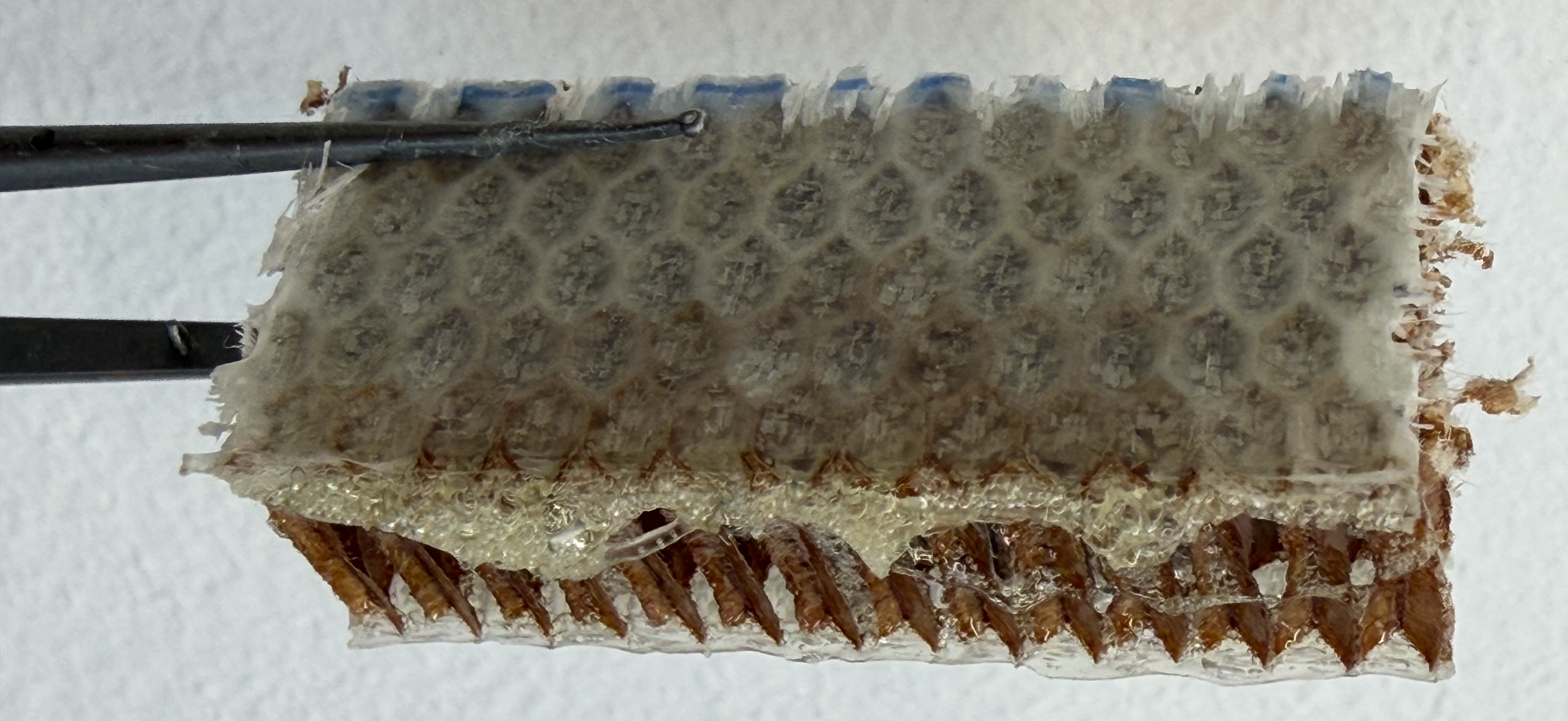
Honeycomb sample, bonded side with modified resin - Photo courtesy Empa
With the right solvent and a little heat, the composite "sandwich" can be broken down into its individual components: the honeycomb structure and the woven fibres. Aramid honeycombs in particular – but also carbon fibres – are relatively expensive. Recycling them is therefore also economically attractive. "In principle, it’s also possible to recover the epoxy resin itself from the solution. We plan to tackle that in future projects," says Dr Gaan.
"Our material complies with fire safety regulations and achieves nearly the same advantageous mechanical properties as conventional epoxy," says Dr Gaan. "For the first time, it allows for complete recycling of the composite material."
Dr Gaan and his team worked with their industry partner Elantas – part of the German specialty chemicals group ALTANA.
In 2024, the European Commission estimated that out of six million boats in the EU, only around 1–2% are effectively dismantled and recycled; the rest are either stored by their last owners, incinerated, landfilled, or abandoned, creating litter and polluting our coastlines and marinas. Although the problem is more acute in smaller yachts, a large number of superyachts between 30 and 40 m LOA are constructed in GRP or with carbon-fibre superstructures.