
Categories
Panoblu Launches 360-Degree Situational Awareness Camera System
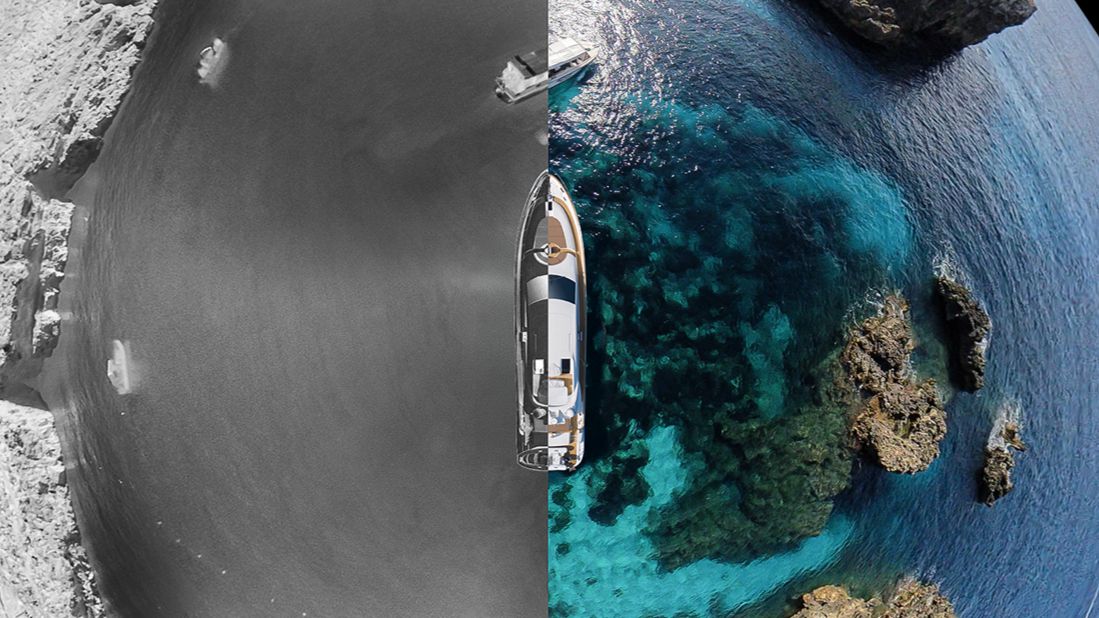
Situational awareness is vital and recent advances in imaging technology paired with AI tools have come so far as to enable remote-controlled commercial vessels. Maltese tech firm Panoblu has met the challenge with its new camera system that mounts on a mast and provides 360-degree visual and thermal imaging and recording.
What sets Panoblu’s solution apart from competitors is that the 360 degrees runs in both axes, horizontal and vertical. The camera is built in carbon fibre over a stainless-steel core, weighs 5.5 kilograms depending on configuration, and mounts high on the mast. Crucially, it provides a continuous, uninterrupted live view around the horizon and vertically, looking down at the vessel's own decks and waterline as well as up into the sky for helicopter operations. The camera unit records continuously, providing captains and watch crew with the ability to review incidents wherever they took place at or near the vessel, including man-overboard incidents.
Sascha Kunze, commercial and operations director at Panoblu, says that the company has been developing its product for years, settling on sensor suppliers and evolving the product focus from a leisure-oriented product to a situational awareness tool. Because no cameras need to pivot or swivel into position, the Panoblu camera provides continuous coverage instantly.
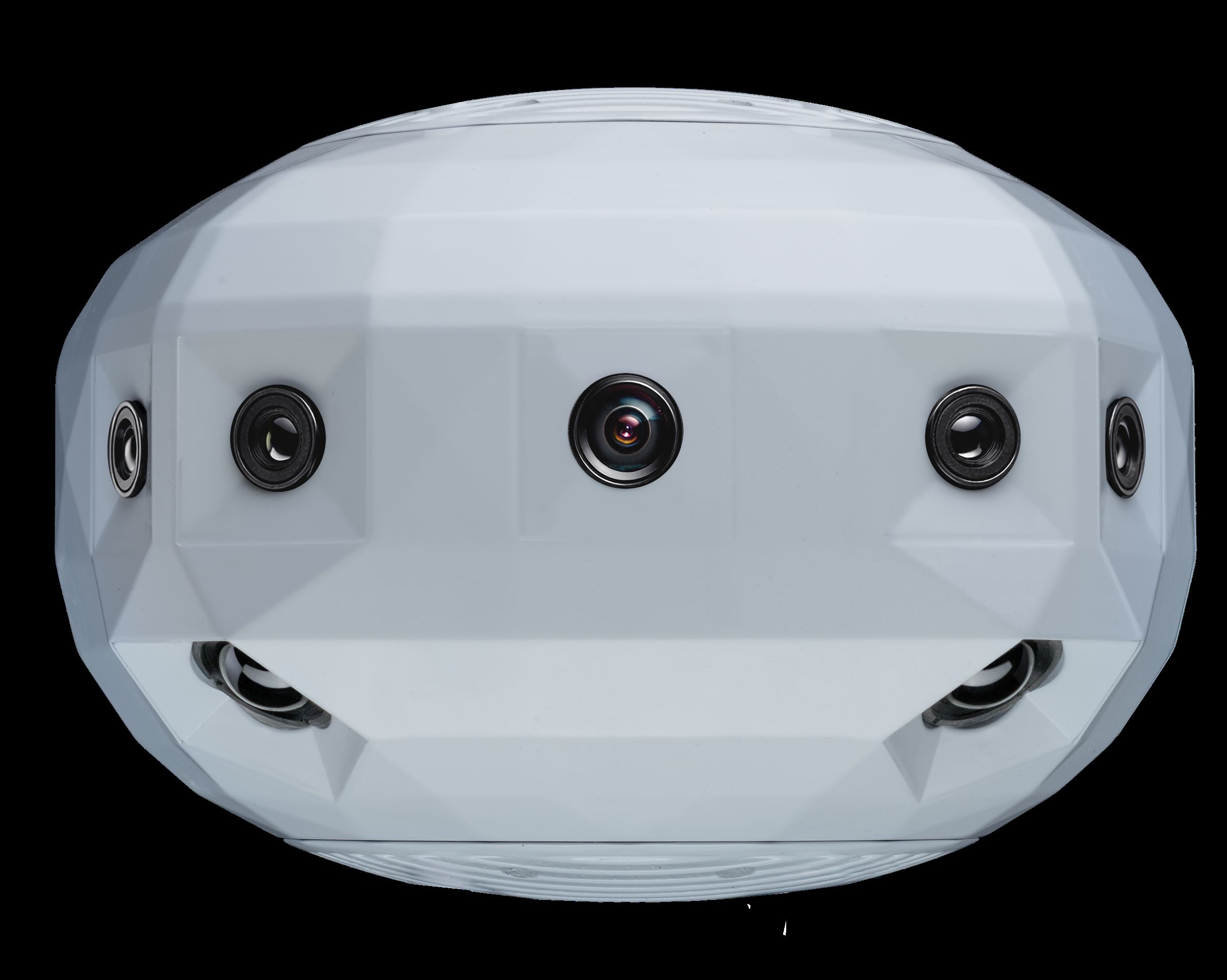
The Panoblu camera is housed in carbon fibre, weighing approximately five kilogrammes
“We take the visual spectrum and the thermal spectrum to a point where it's the same 360° view as a radar,” says Kunze. Captains and deck officers can toggle between visual imaging and thermal imaging as needed. Every system ships with RAD, Panoblu's Range Awareness Display, which overlays configurable distance indicators on the live 360-degree view. The camera is also AI-ready, meaning the processing hardware is on board for image detection, with alarms and zones on the roadmap.
The most obvious applications are in collision avoidance and security. The thermal imaging allows for effective man-overboard searches, awareness of semi-submerged objects or ice at night, and security while the vessel is docked or at quayside to prevent stowaways, intruders or waterside vandals. For man-overboard situations, the video recording is also connected to GPS coordinates, allowing the vessel to search the exact spot where the MOB took place, and even enables retroactive tagging the moment the person went over.
Kunze points out that the resolution on the Panoblu Ultra camera is sharp enough to allow for the creation of 3D images of coastal waters and shorelines. “That’s where we think we can help facilitate mapping and geoscience projects,” he says. Such capability might also be of interest to owners of expedition-style superyachts.
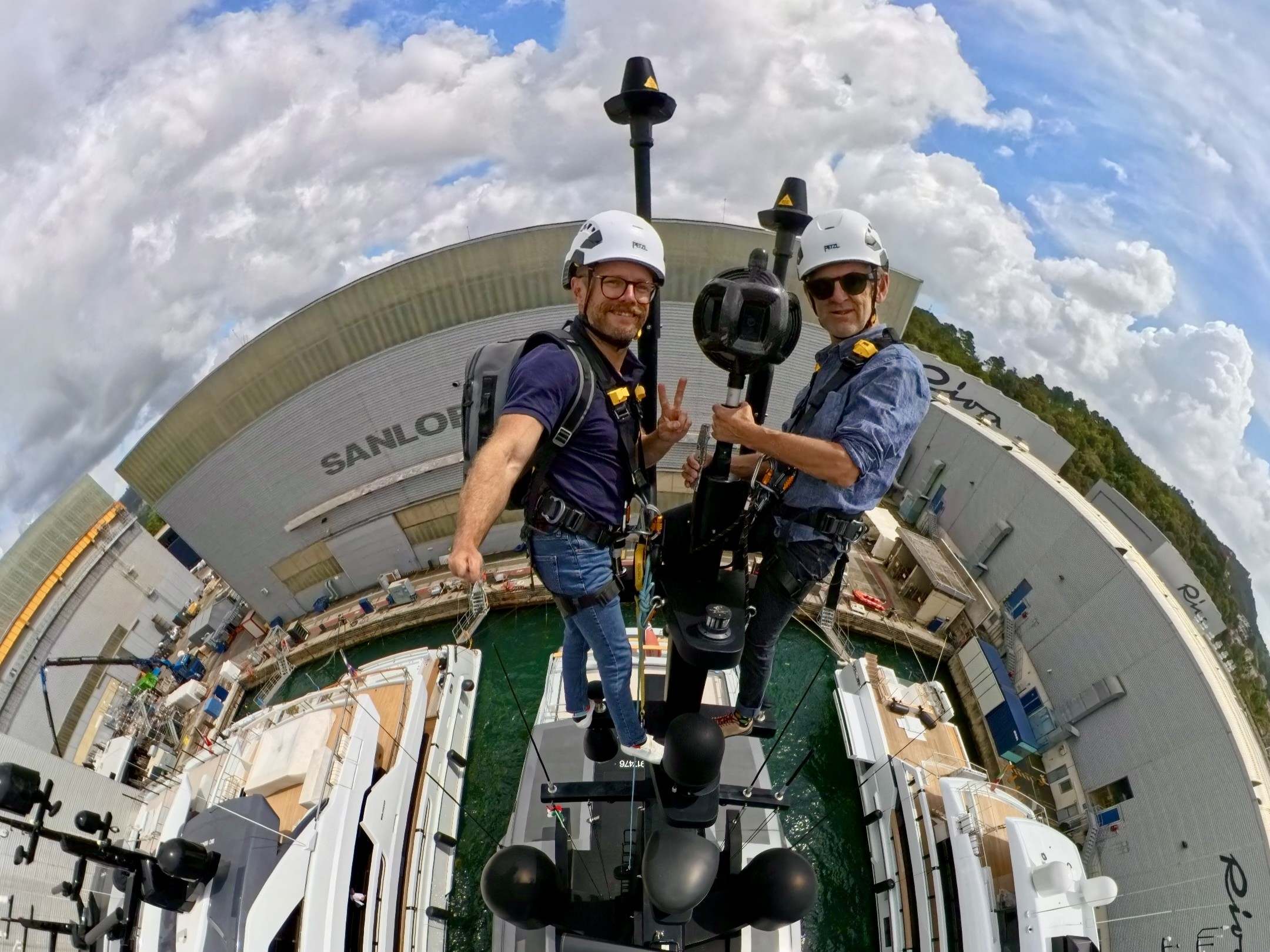
Sascha Kunze (left) says Panoblu secured three superyacht installations in one day. Photo courtesy: Panoblu
The Panoblu solution starts with basic 360-degree imaging. Thermal imaging can be added, along with sky-view for helicopter and drone awareness. At the top of the range, the Panoblu Ultra adds a photographic array producing 128-megapixel stills. Recording is onboard as standard, with 2TB giving roughly two months at archive resolution, and the system can run entirely self-contained on the vessel. Panoblu cloud storage is available as an option.
Thermal imaging works by detecting the infrared radiation (heat) naturally emitted or reflected by objects and converting differences in heat into a visible image, allowing cameras to see people, vessels, and objects even in darkness or poor visibility. Cheaper night vision relies on amplified ambient light but suffers limitations when looking for people in the water or semi-submerged objects, or in fog and adverse weather.
Kunze says the thermal tier Panoblu uses is a deliberate choice. Cooled sensors exist, but they fall under export controls that would pass a compliance burden on to the owner and the vessel. “The technology we're using is the one that sits below those restrictions,” says Kunze. Military-grade variants are possible, he says, but only through properly cleared channels.
Panoblu now has product in stock and installations underway. The company is in talks with European yards building above 50 metres, and three new projects were registered by its dealers in a single day, according to Kunze, suggesting that the best in situational awareness is in sight.