
Categories
Lloyd’s Register: “Momentum builds behind nuclear shipping”
The world of future fuels is also a world of uncertainty. Will it be HVO, methanol, green hydrogen, battery-electric, or something else? The option of nuclear power aboard commercial vessels is now gaining steam according to Lloyd’s Register, and that could signal a possible future for megayacht engineering.
In a recent release after the Posidonia 2026 show, ship classification society Lloyd’s Register noted that “growing interest from governments, regulators and industry is moving nuclear-powered shipping from long-term possibility towards practical implementation.”
LR invited a panel of experts from the nuclear and maritime industries to discuss practical steps towards implementing nuclear power, particularly in the form of Molten Salt Reactors (MSRs), which are more compact and considered much safer to operate than traditional high-temperature, high-pressure reactors.
Among the key requirements identified by all participants was the need to ensure regulatory frameworks kept pace with technological developments.
LR is working with Deployable Energy, a US-based nuclear power start-up that is developing the Unity battery – a 1-megawatt, factory-built, sealed, plug-and-play nuclear power system designed to fit inside a standard shipping container. Deployable Energy’s modular design will allow power scaling. LR is working with Deployable Energy to create a ‘micro-generator’ solution for the maritime industry.
On 1 July, Deployable Energy announced that its demonstration reactor, Unity, had achieved initial criticality at the National Reactor Innovation Center located at Idaho National Laboratory (INL), just 150 days after the project began. Criticality is the point at which a nuclear reactor sustains a controlled, self-supporting chain reaction.
Designers and shipyards have already begun to think about the possibilities offered by modern nuclear reactors for the maritime sector. In 2021, Singaporean investor-businessman Aaron Olivera announced a showstopping 275-metre superyacht design called Earth 300, which was to be powered by an MSR. Funding failed, however, and the project has since gone dormant. In 2022, Norwegian shipyard Ulstein, famed for its ship design, announced a concept for a cruise ship support vessel powered by an MSR, named Thor. The vessel would provide power to electrically operated cruise ships navigating in Antarctica.
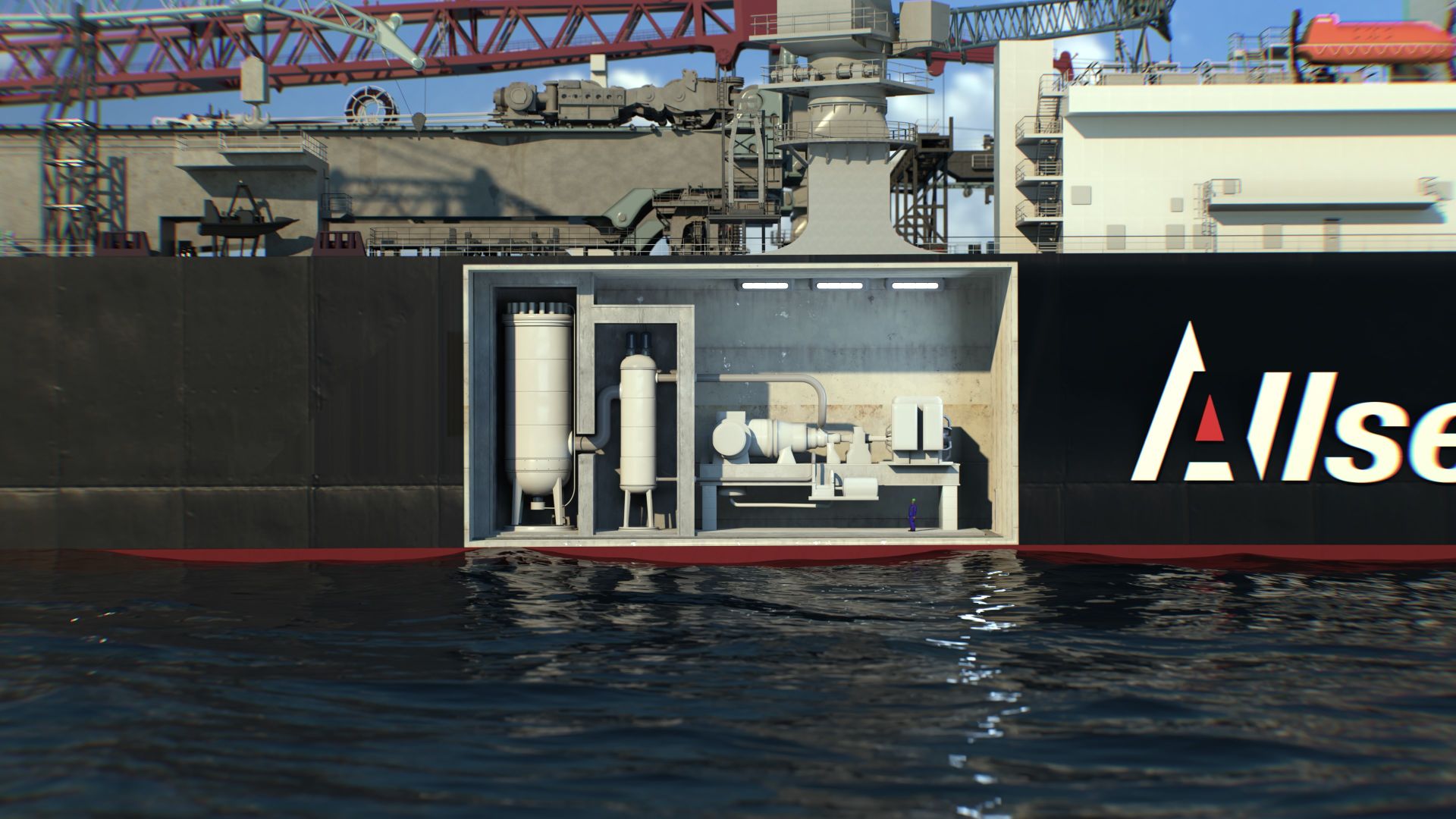
Offshore engineering contractor Allseas now has a nuclear division, with stated plans to launch a marine-suitable nuclear reactor module based on a high-temperature, gas-cooled reactor (HTGR) design. The reactor uses tiny particles of uranium the size of a poppy seed to provide safe power. Allseas says it wants to introduce its reactor to the industry by 2030.
LR cited increasing technical development in this area, highlighting a joint development project with Hyundai Heavy Industries, Korea Shipbuilding & Offshore Engineering (KSOE), Hyundai Glovis, G-Marine Service, and the Korea Atomic Energy Research Institute (KAERI) to explore the application of an advanced small modular reactor aboard a pure car and truck carrier (PCTC).
In June, LR, the Port of Rotterdam Authority, CORE POWER, and A.P. Moller - Maersk published a study exploring the requirements for nuclear-powered commercial ships to make routine port calls in Rotterdam.
Superyacht owners wondering about the possibilities and promise of nuclear power may find their answers soon if regulatory frameworks and port infrastructure capabilities come online. The promise, of course, is years of emissions-free, silent cruising without refuelling. What seemed outlandish just a few years ago may well be turning into a real possibility.