
Categories
Has a revolution in superyacht propulsion arrived?
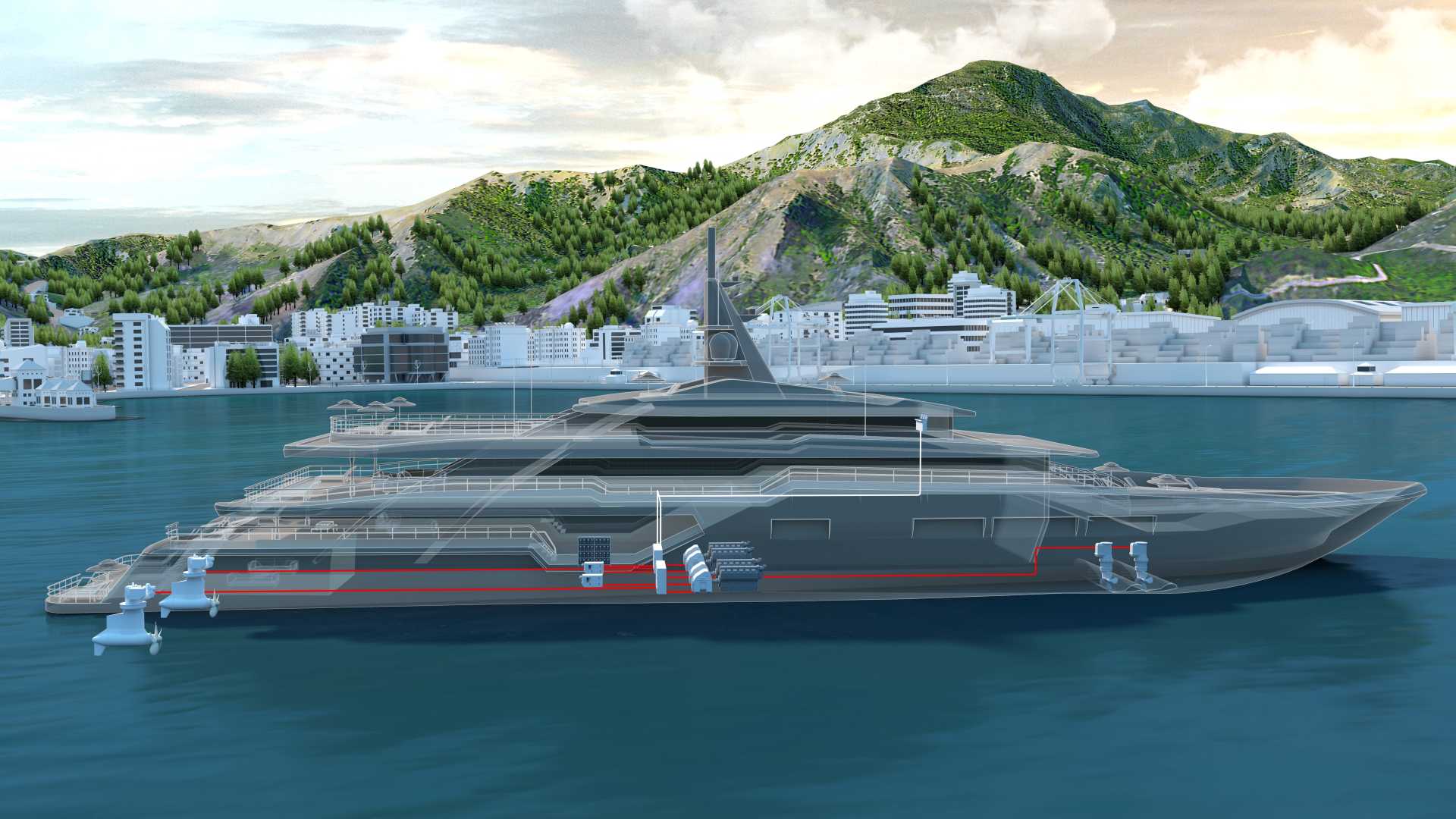
This year, Amels Yachts will deliver the 120-metre Tanzanite, the gleaming new flagship for the famed Dutch yard. While most will be gawking at the deluxe design by Espen Øino, the propulsion system is a story in its own right.
The owner and the yard have opted for a rim-drive podded propulsion system as the primary propulsion for this ocean-going palace, rather than a traditional prop-and-shaft arrangement. A diesel-electric system will power Kongsberg Elegance® pods, which feature direct electric drives with permanent magnet electric motors. The choice of electric pod propulsion will reduce onboard noise and vibration, as well as increase efficiency. Amels claims that the noise and vibration levels will be the lowest "ever recorded on a yacht of this size."
The overwhelming majority of superyachts are still produced with traditional propeller and shaft-line propulsion—it is well-understood technology, offers lower upfront costs, and is easier to maintain. But the allure of alternative propulsion is growing, partly due to the desire to find more fuel-efficient ways of operating, and partly due to a growing awareness of the reliability and benefits of alternative main propulsion systems.
Pod propulsion is used in some of the toughest maritime environments; most vessels involved in offshore engineering use podded propulsion paired with dynamic positioning systems in the harshest seas. And, believe it or not, crew comfort is a top priority for modern offshore vessels.
In 2006, Benetti launched the 65-metre Ambrosia III, possibly the world’s first superyacht to feature azimuth podded propulsion. Reportedly, it could reach cruising speed while operating on just one of its four main generators.
Fuel efficiency was not a hot topic then, but it certainly is now. Also high on the list are guest comfort, the reduction of noise and vibration, and the demand for space onboard. While traditional prop-and-shaft systems offer simplicity, they also require more room internally. Pod systems offer a smaller footprint, thus creating more room for storage or even greater design possibilities.
Earlier this year, ABB announced that it had signed a contract with Oceanco to supply an integrated electric power and pod propulsion system for two superyachts under construction for delivery in 2031 and 2032. This latest announcement marks a continuing development in technology and propulsion between the two companies. ABB previously supplied two 2.5-MW Azipod® units, together with propulsion drives and controls, to a recently delivered Oceanco superyacht. In 2025, the two companies also jointly tested the pioneering ABB Dynafin™ cycloidal propulsion concept at the Marine Research Institute Netherlands (MARIN), confirming its efficiency and sustainability benefits for superyachts.
Cycloidal propulsion may seem like space-age technology, but it was invented by the German ship engineering firm Voith Schneider in the 1920s. The Voith Schneider propulsion system consists of a set of downward-facing blades that spin around an axis and can be individually altered as they spin, thus generating thrust. The system allows vessels an incredible degree of manoeuvrability and fuel efficiency on shorter transits, though it is less efficient on longer transits with minimal manoeuvring.
So far, the Voith Schneider system has not been sold to a cruising yacht, but that may change soon. The system was deployed on the research vessel Falkor (too), which is used by the Schmidt Ocean Institute, a non-profit scientific research organisation established by former Google CEO Eric Schmidt. Icon Yachts offers Project Master, a 70-metre refit explorer yacht equipped with twin Voith Schneider e-propulsion systems. These propulsion systems will eliminate the need for stabilisation systems whilst under way or at zero speed; rudder systems are also not needed. Further, by electrifying a Voith Schneider propulsion system, one of the key drawbacks—difficult maintenance—is reduced.
In late 2025, Royal Huisman unveiled the Aera design, which features a catamaran hull and a wingsail designed by Artemis Sailing. Powered by electricity, the yacht has twin 500kW azimuth pod thrusters with forward-facing propellers. These can be retracted into the hull while the vessel is under sail power, reducing drag in a way that a shaft-line and propeller system could not. This system also eliminates the need for stern thrusters, allowing increased space onboard.
As demand for onboard comfort, efficiency, shallow-water operation, and silent running increases, expect to see fewer propellers and more pods in the world’s superyacht marinas.